
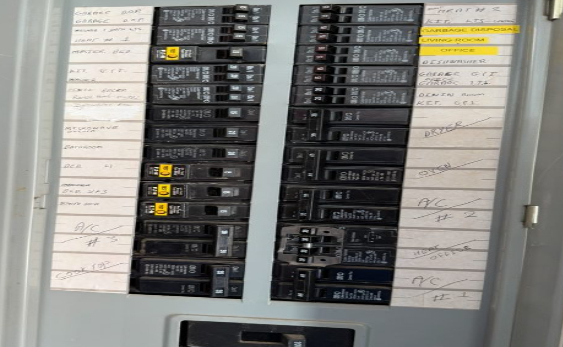
Adding a Level 2 EV charger at home sounds simple until you open the panel door and see that every slot is used. A “full” panel does not always mean you must replace everything, but it does mean you need a plan. EV chargers run for hours, so they are treated as a steady load. If you squeeze one in the wrong way, you can trip breakers, overheat wires, or fail inspection. The good news is there are several safe paths: better load planning, a small subpanel, smart load management, or a service upgrade when needed. This blog explains each option in plain terms so you can choose the right fix. You will also learn what to check before buying equipment.
First, Confirm What “Full Panel” Really Means
A panel can be “full” in two different ways: it can be out of physical breaker spaces, or it can be close to its total amp rating. Start by reading the label inside the door. It usually shows the panel rating (often 100A, 150A, or 200A) and the brand and model. Also, look at the main breaker size, because that is the limit for the home’s service. Next, count open slots and check if any breakers are already “tandem” style, which is a single breaker that holds two smaller switches. Not every panel is approved for tandems, so you cannot add them just to make room.
Quick safety scan:
Any rust, heat marks, or buzzing sounds
Loose or crowded wiring near the breakers
Older panels with known safety issues
If you see damage, stop and get help. A clean, modern panel may still be tight, but it gives you safer options.
Do A Simple Load Check For Safety
Even if you find a free slot, you still need to know if your home can handle the added load. Level 2 EV charging is a “continuous load,” meaning it can run for three hours or more.
Sizing rule to remember:
The circuit must be sized at 125% of the charger’s output. A charger that pulls 32 amps needs a 40-amp circuit, and a 40-amp charger needs a 50-amp circuit.
Many chargers let you set the max amps in the app or on the unit, which can help fit your limits. An electrician can do a load calculation that looks at HVAC, water heater, range, dryer, and other big items.
Before you buy a charger, write down:
Main breaker size
Major electric appliances
Plans for upgrades, like a heat pump
This keeps charging steady and helps avoid inspection issues.
Use Smart Load Management Instead Of Upgrades
If your panel is short on capacity, smart load management can be a solid fix without raising your service size. This may be called an EV energy management system (EVEMS). A small device measures home use in real time. When the house load is low, the charger runs faster. When the load rises, the charger slows down or pauses. This keeps the main breaker within its limit. It can work well for homes with 100A service where an upgrade is not a good fit right now. Look for gear that is safety listed (such as UL) and allowed by your local code.
Common times it helps:
Overnight charging
When cooking or doing laundry
When HVAC starts up
It may charge more slowly at peak moments, but it stays safe.
Add A Subpanel Or Tidy Circuits Carefully
When the issue is space, not total capacity, you may be able to create room by reorganizing circuits. One option is adding a small subpanel. A subpanel is a second breaker box fed from the main panel. It moves a group of existing circuits, like lights and outlets, into the subpanel, freeing slots for the EV charger breaker.
Where subpanels help most:
They can be placed closer to the garage, which may shorten the long wire run for the charger.
Another option is replacing certain breakers with approved tandems, but only if your panel label allows them. An electrician may also correct circuits that were poorly added over the years.
Safe ways to free space often include:
Moving low-load circuits to a subpanel
Replacing an oversized breaker with the correct size
Removing abandoned wires from old projects
Do not double-tap wires under one screw or share a neutral the wrong way. Those shortcuts can cause heat and inspection failures.
Know When A Service Upgrade Is Needed
Sometimes the honest answer is that the home needs a service upgrade. If your main breaker is 60A or 100A and you already run many electric appliances, adding a Level 2 charger may push things too far. An upgrade usually means moving to a 200A service, replacing the meter base if needed, and installing a new panel with more spaces. This is not only about the charger. It can reduce tripping and make room for future items like an electric water heater. Upgrades require permits and a utility disconnect, so planning matters.
Signs an upgrade is likely the right call:
Breakers trip when you cook and run laundry
The lights dim when the HVAC starts
You plan to add more electric loads soon
The panel is old or has limited approved breaker types
Ask for a clear scope: new grounding, bonding, labeling, and a dedicated 240V circuit for the charger. That is what makes it safe.
Safe EV Charging Starts With The Right Plan
A full panel does not have to stop home EV charging. The right fix depends on whether you lack breaker space, total capacity, or both. Smart load management, a subpanel, or a service upgrade can all work when done the safe way. If you are looking for reliable electrical services, Copper Electrical Services can check your panel, run a load calculation, and install the proper circuit for your charger. You get a setup that charges well, passes inspection, and fits your home.